Monday, June 13, 2011

Eastern Victoria - Southern New South Wales

The Rail Trail

The East Gippsland Rail Trail entering Colquhoun State forest
Turning old railway corridors into bike trails is a great idea, but I can’t help thinking it’s an even better idea to put trains back on them - or rather, not to take trains off them in the first place.  The value of the  resource that has been squandered by abandoning the 97 kilometre railway line from Bairnsdale to Orbost defies the imagination. Dozens of old timber bridges, now collapsing or in disrepair, span the deep mountain gullies and ravines through steep, lush farmland and the magnificent Colquhoun State Forest.  The biggest, at Stony Creek, is 20 metres high and 293 metres long, and was built in 1916 using only manual labour and timber that was cut and  hauled locally.  It’s an impressive tribute to the ingenuity, adaptability and sheer muscle of its builders, and the cost of replicating it today would be staggering.  So now, the old railway line has been transformed into the East Gippsland Rail Trail.  Only light bailey bridge-style structures are needed to carry cyclists, walkers and horse riders across the creeks today, and it’s certainly a great ride.  Because it was once a railway, all the grades are gradual, so the riding is fairly easy despite the fact that you’re traversing steep, mountainous country.  

Stony Creek Bridge.  Built 1916
Unable to resist basking in the winter sunshine, I started late from Bairnsdale, and meandered along the Rail Trail for 30 kilometres enjoying the scenery and meeting not a single soul.  After lunch in the park at the pretty mountain town of Bruthen, I managed another gentle 30 kilometres through the Colquhoun Forest which brought me to the outskirts of Nowa Nowa.  


I had stocked up with food that morning, expecting to bush-camp, so I had no need to go into town- if, in fact, the half dozen buildings straddling the junction of the Princes Highway and the Bruthen - Nowa Nowa Road can be called a town. I camped under cover amongst the trees to protect myself from the worst of the cold. The tent fly was encrusted with ice in the morning, but my new polypropylene sock liners solved the cold feet problem.

The floral emblem of the State of Victoria: Epacris Impressa - Pink Heath

Even though not a drop of rain had fallen on me, the track was becoming wetter and softer  from earlier rain as I travelled East.  With this in mind, I swapped the Rail Trail for the Princes Highway and diced with the log trucks for the last 35 kilometres into Orbost.  It was another sunny morning, but the wind was getting stronger and was now icy.  A check of the weather forecast on the Internet at the Orbost Community Centre showed a massive cold front, directly from Antarctica, approaching Victoria’s Eastern coast.  My luck with the Victorian winter weather appeared to have suddenly run out.
A couple of emus by the roadside near Orbost weren't emused (sorry) by my camera
The front was expected to cross the coast that afternoon, and the forecast was for freezing gale force winds, rain and hail for the next three days.  With the towns at least 60 kilometres apart in this far Eastern region of Victoria, I would be totally exposed to the wild weather on a bike out on the highway.  Riding on wasn’t an option.  By the time I emerged from the Community Centre, black clouds with an ominous green tinge were massing in the South.  A quick check of Orbost’s accommodation options revealed that it would be an expensive option for me to hunker down there for three days and wait for the weather to improve.  Reluctantly, I decided to put myself and the bike on an overnight bus to somewhere North of the expected path of the cold front.  Bateman’s Bay, 360 kilometres away towards Sydney, seemed to be the nearest place likely to escape the worst of the weather. I booked a seat on a bus leaving Orbost at midnight.
Conversations in a pub.
By mid-afternoon, it was dark, cold, windy and wet, and I took refuge in the pub.  (As you do!)  I still had eight or nine hours to wait till my bus was due, so I parked myself in a warm corner of the bar with my book.  That evening, a darts tournament started up in the bar, and  the place began to fill up.  As my quiet corner became more and more crowded, I was 
inevitably drawn into conversations.  “What yer readin?”  “Where’r yer from?”  “Whaddya reckon ter this bloody weather?”  Good-natured banter in a country pub.  One fairly drunk  twenty-something button-holed me for a while and regaled me with deer hunting stories.  He was very keen that I should acknowledge the superiority of his particular make of hunting rifle, and the rightness of deer hunting in general.  Of course, I agreed.  
As the pub gradually emptied out later, I fell into conversation with two men: Dave, a Telstra worker in his 50s, and Bill, a recently retired police sergeant.  Dave was more than a little drunk by this time.  The conversation turned, inevitably, to what Dave called “the Blacks”.  He’d done quite a bit of work around the Aboriginal community of Lake Tyers - a place that was once infamous for the incarceration of Aboriginal people from all over Victoria - a sort of equivalent of Queensland’s Palm Island.  Nowadays, Lake Tyers is Aboriginal-owned, and Dave was expressing his disgust that it had been “given” to “the Blacks” - that they hadn’t had to pay for it.  Between Bill and I, we got him to acknowledge that the land had been stolen from them in the first place, but that didn’t change his view that the fact that they were, in his words, getting something for nothing, was an affront to him personally.  “My tax dollars”, he kept repeating, “and they paid nothing for it - nothing!”
I’d heard this kind of angry invective before - many times, and I knew better than to get drawn into a debate about it, particularly with a drunk, but what was really interesting to me was the attitude of Bill, the ex-policeman.  Bill had spent years dealing with the contrary behaviour of Aboriginal youths in the Gippsland area; he was a front-line soldier in the constant battle between disenfranchised black kids and the law.  He could have been expected to be angry and negative about them.  But his was the voice of patience and tolerance.  Without directly contradicting or antagonising his ranting mate, he persistently referred to the reasons behind the behaviours - to the history.  Later on, as I left the warmth of the pub to wait in the cold for that midnight bus, Bill strolled past on his way home.  He told me that if the bus failed to arrive, I was welcome to spend the night at his place.  He told me where it was, that the door would be unlocked and that the dog was harmless.  “Just come in”, he said over his shoulder as he walked away.  “Make yourself at home”.  
Back on the road
I slept fitfully on the five and a half hour bus trip to Bateman’s Bay.  I was sorry to miss out on cycling this very scenic part of the Southern New South Wales Coast, but the wild weather would have made it impossible to enjoy.  I know the area quite well: as a child, I holidayed at the timber and fishing town of Eden with my family a number of times.  The tuna fleet is gone now, having cleaned out the fish stocks long ago.  The state forests around here are still commercially logged - hopefully with some of degree of planning and restraint these days.
The bus pulled in to Bateman’s Bay at 5:30 am.  It was dark and cold, but nowhere near as cold as Orbost.  I went looking for breakfast and, of course, the only place open at that hour was McDonald’s.  I feel like a traitor to culture and civilisation when I walk through the door of one of these places.  Along with massive shopping malls they belong in Clive James’s category of “Abbattoirs of the Human Soul”.  The decor was a crime against taste and decency; the coffee was almost drinkable; the food was a heart attack in a box; BUT - they had free wi-fi!  I spent the dismal hour before the sun came up checking my emails and keeping warm.
When it did come up, the sun was glorious.  I spread out my gear on a picnic table by the river, dried everything out, and pottered around happily on the little beach.   As I was repacking my tent, an Aboriginal couple strolled past.  (Bateman’s Bay has a substantial Koori population.)  The man asked me if I was camping out that night, and recommended a hidey hole in the scrub behind the fire station, where, he said, you could see the people walking by, but they couldn’t see you.  He explained that he had used the place often when he was “on the grog”.  Sound advice from the voice of experience.

Suffering in the iron grip of winter at Bateman's Bay
As it was, though, I decided to stay in the local Youth Hostel.  Isn’t it odd that Youth Hostels are full of old fogeys like me these days!  I had a pleasant evening chatting to the only other guests: a couple of kiwis travelling through by car.  The next day dawned cloudy and showery, but the temperature was mild.  I rode off happily along the highway towards Ulladulla.

Monday, June 6, 2011

On the road

From one “safe house” to another on day one, I cut across the Eastern suburbs of Melbourne from Base Camp - my sister Diane’s place in Eltham, to Launching Pad - the home of the sensationally hospitable Peg and Ian Shepherd in the South-Eastern suburb of Mentone.  Heading out of Melbourne the next morning, I negotiated an endless stream of trucks for the first couple of hours.  After Cranbourne, the road widened and felt safer, but the trucks persisted until I turned east for Korumburra.  The South Gippsland Highway was still busy with private cars.  This was a quiet rural area last time I came this way, but the development has been intense.

At Koo-Wee-Rup, I climbed an observation tower, and got a glimpse of the flat, shiny expanse of Westernport Bay to the south.  The information board at the base of the tower provided a potted history of the district, featuring a portrait of an Aboriginal elder from the 1880’s and his “lubra”.  The portraits, taken from a newspaper of the time, bordered on the grotesque, with absurdly exaggerated features.  I’ve noticed this often in 19th century drawings and paintings of Aboriginal people.  The artists seemed to have a need to denigrate their subjects, perhaps to help justify the dispossession, theft and murder being carried out by the rest of white society.


 The Koo-Wee-Rup noticeboard presented the portraits without comment, followed by a heroic account of the draining of the huge swamp that dominated the area before European settlement.  No doubt this ambitious undertaking was a boon to the growth of farming in the district, but it almost certainly destroyed a major source of food and other necessities for the local Aboriginal population.  Needless to say, this “downside” wasn’t mentioned on the historical noticeboard.


 In total, on the day, I rode 100 kilometres to Korumburra in South Gippsland.  That was probably too ambitious for my first serious day’s riding in ten months.  I was already exhausted before tackling the foothills of the Strzelecki Ranges in the last 30 km.  The climbing really challenged me, and I limped into Korumburra after dark, stiff and sore.  To add insult to injury, the campground turned out to be at the bottom of an enormous hill, making it difficult (but not impossible) for me to struggle back up into town for a drink later.  I had a long, hot shower, a cup of tea and some pasta before crawling into my thermals, my sleeping bag and my tent.  A beautiful, clear night after a cool, sunny day promised a frosty morning, so I made sure I was prepared.


The South East Gippsland countryside is lush and green, flat to undulating - a rich agricultural district.  The towns of Korumburra and Leongatha are pleasant and prosperous.  The building of freeways and arterial roads has put them within reach of the south-eastern industrial suburbs of Melbourne, and no doubt there’s a growing population of workers who commute to that Stygian zone of tilt-slab factories and nose to tail semi-trailers, then return to the relative peace and serenity of the South Gippsland towns.  Travelling through them on a bike, though, is less peaceful than it once was.

In the early hours of the morning, the wind began to rattle my tent as a warmer air mass moved over the State.  A milder morning, cloudy but dry, promised a reasonable riding day. 
Still a little tired and sore, I decided that the 50 kilometres to Foster would be enough for the day.  A few kilometres beyond Leongatha, I discovered the excellent Great Southern Rail Trail: the bed of a disused railway track converted into a bike path.  Three hours of leisurely riding on the hard-packed dirt surface through bushland and farming country brought me all the way to Foster - the turn-off for Wilson’s Promontory (The Prom), the southernmost point of the Australian mainland.  I greeted half a dozen cyclists headed the other way - not long distance tourers, but locals out for a day ride - and had lunch in a picnic shelter on a ridge overlooking The Prom.


  By the time I reached Foster in mid-afternoon, the clouds were heavy and threatening.  I was tempted by a cosy-looking backpacker hostel, but the thirty dollars they were asking seemed excessive, so I decided to camp.  As it turned out, the tent site at a local caravan park was nearly as expensive as the backpacker, but it was too late to go back by then:  I was ready for sleep.

The rain didn’t eventuate, and a fine, sunny day with almost no wind and only an occasional paltry attempt at a shower saw me cover a pleasant 70 kilometres through green, undulating farmland. 


I considered staying in the pleasant town of Yarram, but it was still early afternoon so I pushed on to the tiny township of Woodside.  A local football match seemed to be engrossing the entire population - Woodside Wildcats versus - who cares!  So, after a cold beer in the nearly empty pub I rode on towards Sale, determined to bush-camp somewhere in the State Forest along the way.  As soon as the sun sank below the trees, the temperature plummeted, and my legs chose the same moment to tell me enough was enough.  I took the first forestry track on the left, put 100 metres or so between me and the road, lit a fire and put up my tent.


I quickly realised it was going to be a very cold night.  I read by the fire until it seemed late enough to climb into my thermals and sleeping bag.  When I checked the time on my phone, it was 7:00 pm.  Oh well, might as well go to sleep.  Two things prevented me from sleeping long and peacefully: I couldn’t get my feet warm, and an army of wombats shuffled and snuffled and grunted and scratched outside my tent ALL NIGHT.  Bloody nature!

The morning was clear and sunny, and freezing.  Who’s idea was this winter bike tour anyway?  I made porridge and tea on my spirit stove and set off for the large regional town of  Sale.  The day stayed fine and clear, but a strong, gusty North-Westerly wind hammered at my left shoulder all morning, taking much of the pleasure out of riding.  After an early lunch in Sale, which was largely closed for business on a Sunday, I set out to follow the Princes Highway North to Stratford, then East to Bairnsdale.  The wind picked up,  and the highway traffic was annoying, so I impulsively turned East on rural roads to cut through to Bairnsdale. 

At first, the tailwind was exhilarating, and I became confident of making Bairnsdale easily by nightfall (5:00 pm in these latitudes at this time of year), but the road became hilly and kept swinging around to the North, and I was battling the wind again.  Having ridden 120 kilometres, I limped into town an hour after dark, exhausted and chilled to the bone, and completely violated my principles by checking into a motel, luxuriating in a hot shower, then heading to the RSL (Returned Services Club) for a rubbery roast (which I enjoyed) and a few revivifying ales.  A very fortunate chat with the barman revealed that there’s another rail trail, this one 97 kilometres long, from Bairnsdale all the way to Orbost.   No highway traffic for the next couple of days!  But I will have to bush camp again, so before I leave, a pair of seriously warm socks is going to be acquired.


Wednesday, June 1, 2011

Australia: The Farewell Tour?

What was the most important story in yesterday's news?  Some puerile political spat in Parliament? The latest media celebrity or sports hero to behave like a moron?  Well, for me it was this one:

The International Energy Agency reported that we had already hit the global annual carbon output that had been forecast for 2020. Thirty two gigatonnes went into an already battered atmosphere, a rise from 30 gigatonnes just two years ago, and barely impeded by the global recession -- indeed the recession, by slowing the process of technology changeover, may have exacerbated the process.
(Guy Rundle: Crikey.com)


This dire signal that we are locked in to, at the very least, 2 - 3 degrees of global warming by the end of the century, and probably much more, fills me with dread.  The report was hardly visible, swamped by more trivial and parochial concerns.  You had to look for it.  This fact increases my gloom exponentially.  The planet is sliding towards disaster and we think the sports results are more important.

I'm deeply pessimistic about the the state of the world I'm bequeathing to my grandchildren, and like many others I know, I feel helpless about it.  I've been actively involved in Green politics for some years now, but my ability to actually change anything seems pathetically insignificant.  So what am I going to do?  Get back on my bike!  My new bike, actually.  My 60th birthday present to myself.  I'm going to ride all over this continent that's been my home for 54 years, and say goodbye to many of the places I've known and loved - the Great Barrier Reef (may be gone in my lifetime or my children's), North Queensland's rainforests (ditto), Kakadu, Tasmania's South-West wilderness - and to some places I've never seen but have always wanted to - the South-West corner of Western Australia, Carnarvon Gorge in Central Queensland, Kangaroo Island off the coast of South Australia.

All of these places will be damaged, impoverished by catastrophic climate change: I have no doubt about that.  They'll lose plant and animal species; they'll suffer more extremes of drought, or flood, or storm, or all of the above.  So it's time to say goodbye to what was.  Yes; I'm pessimistic, but the question mark at the end of the title above gives away the fact that I haven't given up all hope.  I hope, through this blog and through other means of publicising my journeys, to send a wake-up call to people to read the real news, think about the real issues, and act now to mitigate the damage - to save what can be saved.  If you'd like to read more intelligent and informed works of "activist pessimism", I suggest Bill McKibben's Eaarth: Making a life on a tough new planet, and Clive Hamilton's Requiem for a Species.

Perhaps this sounds a bit arrogant.  Who am I to think I can change the world by writing about an extremely self-indulgent cycling trip around Australia?  Well, it's about doing what I can do, and also about having some fun while I'm at it.  You see, I LOVE cycle touring.  My two-wheeled adventures in Tasmania, New Zealand, Britain, Ireland and America have been some of the best times of my life.  I fully intend to enjoy this journey (which may take a couple of years, or the rest of my life) while sending out my serious message.

It's my intention that this blog will eventually migrate to its own website with useful links and more sophisticated presentation.  Rather than hold off until I've mastered all the technology though, I'm going to start pedalling and let things develop as I go.  Stage one is a relatively quick, fairly linear ride from Melbourne to Brisbane via the East coast - about two thousand kilometres - over a period of approximately four weeks.  I'm starting on the first official day of winter here in Melbourne, and it's a clear, frosty morning.  The weather will limit me in some respects: I'm unlikely to venture far from the coast because camping in temperatures of minus five degrees celsius (yesterday's minimum in Canberra) isn't my idea of fun.  Other stages of my journey will be more leisurely and less linear, perhaps based on the concept of cycling around a distinct bioregion, rather than travelling from point A to point B.


OK, I know it's pretty nerdy to start off with a picture of a bike, and I promise not to bore you with the technical specifications of my new toy (well, not all of them), but you must admit, it's a pretty sexy machine.

So, here I go on what could be described as a warm up leg of my all over Australia Farewell Tour.  I hope you enjoy it as much I know I will.  Stage One - navigate across the Melbourne Metropolitan Area through murderous traffic, and out into the relative calm of South Gippsland.

Sunday, August 22, 2010

Ends and beginnings

I'm home again in Australia.  The trip is over, but it's not.  This ending is only a beginning.  On the scary ride along US 101 down the Pacific coast, I was already planning my next bike adventure (TBA).  The homicidally close log trucks and RVs couldn't spoil my enthusiasm.


The 600 mile ride south from central Oregon to San Francisco wasn't as lonely as I expected it to be.  I met three jovial Swiss cyclists who were riding from Vancouver to Chile; an Australian living in Vancouver and working in the film industry who was riding to LA for a meeting with his agent; a completely loopy Canadian who was riding to somewhere obscure in California to see his sister; a gigantic Dane who had already ridden halfway around the world - in fact, a reasonable cross-section of the crazies who are out there pedalling the planet.  I'm proud and happy to be numbered among them.


San Francisco turned out be - a city.  I'm not generally keen on cities, and this one didn't offer many surprises.  It featured triumphal architecture, hideous traffic, lots of American flags (ho hum), squadrons of homeless people, urine smells on every corner (the "rest rooms" in every restaurant were "out of order"), brand name shops that are the same all over the world, a spectacular bridge that was shrouded in fog and utterly clogged with traffic, a harbour that might have been spectacular if the fog had lifted long enough for me to see it, cable cars that might have been fun to ride if the queues had been less than half a mile long, milling crowds of people who were mostly tourists from somewhere else, a total lack of affordable accommodation that left me in an expensive motel room that smelled like an ashtray,  and generally very little that tempted me to stay.  I'd spent three months traversing this amazing continent with its wide open spaces and spectacular mountains, and I wasn't about to be seduced by an overpopulated mound of concrete.  We have plenty of them in Australia.


I spent a day wandering the streets of this city, avoiding the tourist traps and seeking the genuine essence of the place.  Here's what I found.

  • For some reason, San Francisco seems to be a magnet for the homeless and desperate. Panhandling is rife.
  • Groups of mainly black men hang around on street corners doing absolutely nothing except smoking - not even talking.  They often manage to look menacing.  It appears to be something they cultivate, perhaps as a response to racism.
  • A huge proportion of people smoke here - especially young people.  You can still smoke in cafes and restaurants.  Cigarettes are relatively cheap.
  • There's always a siren wailing in the next street somewhere.
  • The police officers look sullen and cranky.  Another cultivated look?  At least two thirds of them are seriously overweight or obese.  Their patrol cars are all straight out of the Blues Brothers movie.
  • The wide, grid patterned streets and 19th century triumphalist architecture remind me of Melbourne, and Belfast.
  • There are more tourists here than locals.
  • There's a fabulous farmers' market in the square outside the Civic Centre, selling mostly organic produce.  No matter where you wander in San Francisco, or which streets you turn down, you always end up back here.  I accidentally rediscovered the place about eight times.
  • The fog and drizzle (fizzle?) are pervasive and depressing - and the wind is cold.  If this is summer, I'd hate to be here in winter.  
  • There are actually some independently owned cafes here, unlike most of the US, which has totally surrendered to the fast food franchises and character-free malls that Clive James calls "the abattoirs of the human soul".
  • You can buy decent coffee in San Francisco, although the tasteless, watery, brown stuff that passes for coffee elsewhere in the US is also available if you want it.  The Americans attempt to disguise the taste of this stuff by adding things like artificial hazelnut flavoured powdered creamer.  It just adds insult to injury. 
  • You can also get decent pizza here, which doesn't resemble the bland, cheese-smothered slabs of blubber you might get in Kansas or Missouri.  A slice the size of a baby's blanket is about five dollars, and will fill you up for three days.
  • Micro-brew beers are ubiquitous, and fabulous.  Every corner store sells beer and wine.
  • The BART (Bay Area Rapid Transit) train is a brilliant way to get around.  It's fast, efficient, clean, and - expensive.  
  • The timber suburban houses in the "middling" suburbs are attractive - mostly painted in pastel colours and dotting the hillsides like miniature Mediterranean villas.
Although my stay in San Francisco was brief and the weather was unkind, I did get a strong sense that this is a place with a unique identity.  A place where, provided you had sufficient money, you could have a life.


Why anyone would want to visit Alcatraz - that hideously ugly pile of crap on an already ugly rock in the middle of an otherwise quite attractive harbour - totally escapes me.  I'm one hundred percent certain that it would simply be another piece of Disneyfied Americana.  This country is massively endowed with natural wonders and cultural marvels.  You really don't need to visit the crappy stuff and pay ridiculous amounts of money to experience the ritual trivialisation of history and culture.


Some hitherto undisclosed gems from the TransAmerica tour


In Chester, Illinois, we camped at the Eagles Lodge, a kind of patriotic social club - part workers' club, part masonic-style lodge - where people gather to eat, drink and reinforce their mythological national identities.  The evening's raffle featured two prizes: a Browning pump action shotgun,


and ..... a case of hard liquor.  What a perfect combination.  Only in America!


Signs outside churches provided me with many moments of pure joy.  I've featured a number of these in the blog.  Here are a couple that deserved to be included but slipped through the net.


Hmmm!  I guess this means there must have been some progenitorial action at the crucifixion??????  Kind of changes one's perception of the event.


I mentioned these intriguing folks in the Idaho chapter of the blog, but it happened to be one of those periods when I had "lost" my camera somewhere in the depths of my panniers, so I took the photo with my iPhone and forgot to include it.  Here it is in all its glory.  This is possibly the most confusing piece of religious illogicality I've ever encountered.  I'm open to your informed interpretation, but my poor brain quails at the task of unravelling this.  My understanding is that Jehovah is, in fact, an Anglicisation of the Hebrew, Yahweh.  Here, though, they're clearly two different beings.  One is the saviour: the other is the Devil - and Jesus is the Devil's son.  Is this a Christian sect, or an Anti-Christian sect?  Do they know?  Do they care?  Does it matter?  For me, the most bizarre thing is that is that this mob adopted a 2 mile stretch of the highway, undertaking to clean up the litter and maintain the signage.  Why?  By what stretch of the imagination could they conclude that cleaning up the roadside - in the face of approaching Armageddon - was a meaningful thing to do?  I give up.


Cute critters were definitely a feature too.  I came across hundreds of these little turtles, and rescued lots of them from the roadway.  Those that were crushed by cars and trucks were tragically exploded across the road.  I pay tribute here to the legions of squashed turtles, squirrels, raccoons, opossums, chipmunks, groundhogs, prairie dogs, gophers, deer, salamanders, snakes .....  If you think there's a lot of roadkill on Australian roads, come to America.  Of course, the beauty of travelling on a bike is, you don't just see this slaughter: you get to smell it too.


American patriotism both baffles and terrifies me.  A hideously bad mural like this, in western Kansas, tempts me to laugh, or gag.  But this is a palpable, genuine, undeniable part of American life.  It's real.  They're not faking.  As a school kid, it seemed funny - ridiculous - to ask for a minute's silence on Remembrance Day.  You could request an hour from most Americans in the cause of patriotism, and they'd give it.  What does this say?  I'm not sure.


This is a vast country, about the same size as Australia, but with 300 million people compared to our 22 million.  In the interior, I imbibed a sense of its vastness, and loved it.  The open spaces spoke to me in the way the emptiness of Australia speaks to me.  I couldn't be a Dutchman, or a Belgian, or a German, although there are people from these countries whom I understand and love.  I need this space.  It's part of my,  er .... mythological national identity.


Another thing that endears me to America is the prevalence of seriously bad taste.  A place where this is not only tolerated but celebrated can't be all bad.  This particular example, photographed in Wyoming, was just a few miles from the memorialised site of a "battle" - in fact, a massacre of native people, mostly women and children, by settlers - presented on the signboards and pamphlets produced by the local "Historical Society" with a complete lack of self-conscousness, irony,  or awareness of anything other than  pioneer virtue and antiquarian interest.  What a country!  This almost approaches Australian levels of denial and hypocrisy around the slaughter and demonisation of Indigenous people.

Dramatis personae

Without a doubt, the best part of this fabulous trip was meeting and riding with so many great people -   people unhinged enough to think it was a good idea to cycle across a continent.  Jessica Bell from Gainesville, Florida.  Teacher, grad student, smart, funny person, tough and dogged cyclist.


Ryan Anderson.  Smart, fit, funny Geordie with a lust for life that makes you realise that it's all about NOW! - and Newcastle United.  In the course of the trip, Ryan discovered he has an uncanny ability to break spokes - anywhere, anytime.


Sieman: Belgian political science student.  Powerful rider, delightfully eccentric, crossing America on a smaller budget than most of us would want to cross the street.


Cooper Hanning.  Cool, instinctively social democratic, compassionate, sensible man from Minnosota - of impeccable Swedish descent, impressive physical prowess, fundamental decency and instinctive friendliness.


Eli.  Only rode with him for two days. Joyously free spirit from upstate New York.  His love of life is infectious, and he chooses to navigate it without a roadmap.


Wim Verheyen.  Flemish bon vivant, cyclist extraordinaire, generous human spirit.  His wit and irony helped to enrich my experience of America.  A man worth communing with.


Joe Meyer (aka Jeremiah).  Why take a ferry across the Ohio River when you can swim it?  Who cares if you almost get swept downstream to the Gulf of Mexico!  This episode neatly illustrates Joe's approach to life.


Stefaan Vermeulen - our Belgian / American "tour guide and booking agent", who's been everywhere before and always phones ahead to book a campsite.  His idea of moving house from Durham, North Carolina to Portland, Oregon was to send his stuff by truck and travel there himself on a bicycle.

These were my companions at various times and for significant sections of the tour.  There were others who came and went, but this was the core of the "Transam Team" that crossed the Rockies together and shared the highs and lows, the laughs, the drinks, the broken spokes and flat tyres, the gruelling climbs,  suicidal descents, murderous trucks and RVs, blistering heat and bitter chills that make up a transcontinental bicycle tour. It was a pleasure and a privilege to travel with them.  We've exchanged email addresses, so it's only a matter of time before someone comes up with a totally ridiculous idea for another tour.  I can't wait.

So that's it for America - for now.  I was scrolling through my photos for the one iconic image that sums up the place, and this one comes pretty close, for me anyway.


Wednesday, August 11, 2010

Redwoods and Sea Fog


The five remaining members of the Intrepid TransAm Team cruised into Florence, Oregon in fine style.  Actually, that's not true: it's just the way it was supposed to be.    Jessica had a flat tyre two miles out, then, when we stopped in a confused bunch at an intersection without any idea of how to get to the Pacific Ocean, she gently bumped into Wim's bike.  Being clipped in to her pedals and unable to get a foot out in time to brace herself, she fell over sideways in a very ungraceful manner on the roadway.  We then discovered we still had five miles to ride to the beach.  When we finally arrived, Jessica's mother, who had flown out from Florida with her partner for the occasion, met us with two bottles of champagne in the carpark.


The beach turned out to be an unappealing expanse of grey sand bordering an equally unappealing expanse of grey, freezing ocean.  The wind was bitterly cold.  Nevertheless, two insane Belgians and one Geordie (the name implies insanity) decided to swim.  Jessica and I sipped champagne and
huddled in our jackets while they pretended to enjoy themselves, leaping about in what, just a little way north of here, is called the Arctic Ocean.


The next morning we had a farewell breakfast in a cafe in the Old Town area - the only attractive part of a town completely choked by shopping malls and used car lots and bisected by the constantly busy US 101.  While the others headed for Portland, and their various routes home, I threaded my way between the trucks and RVs, alone on the scary Highway 101, heading south for San Francisco.  I was already missing the camaraderie, the support, the company of these great people.


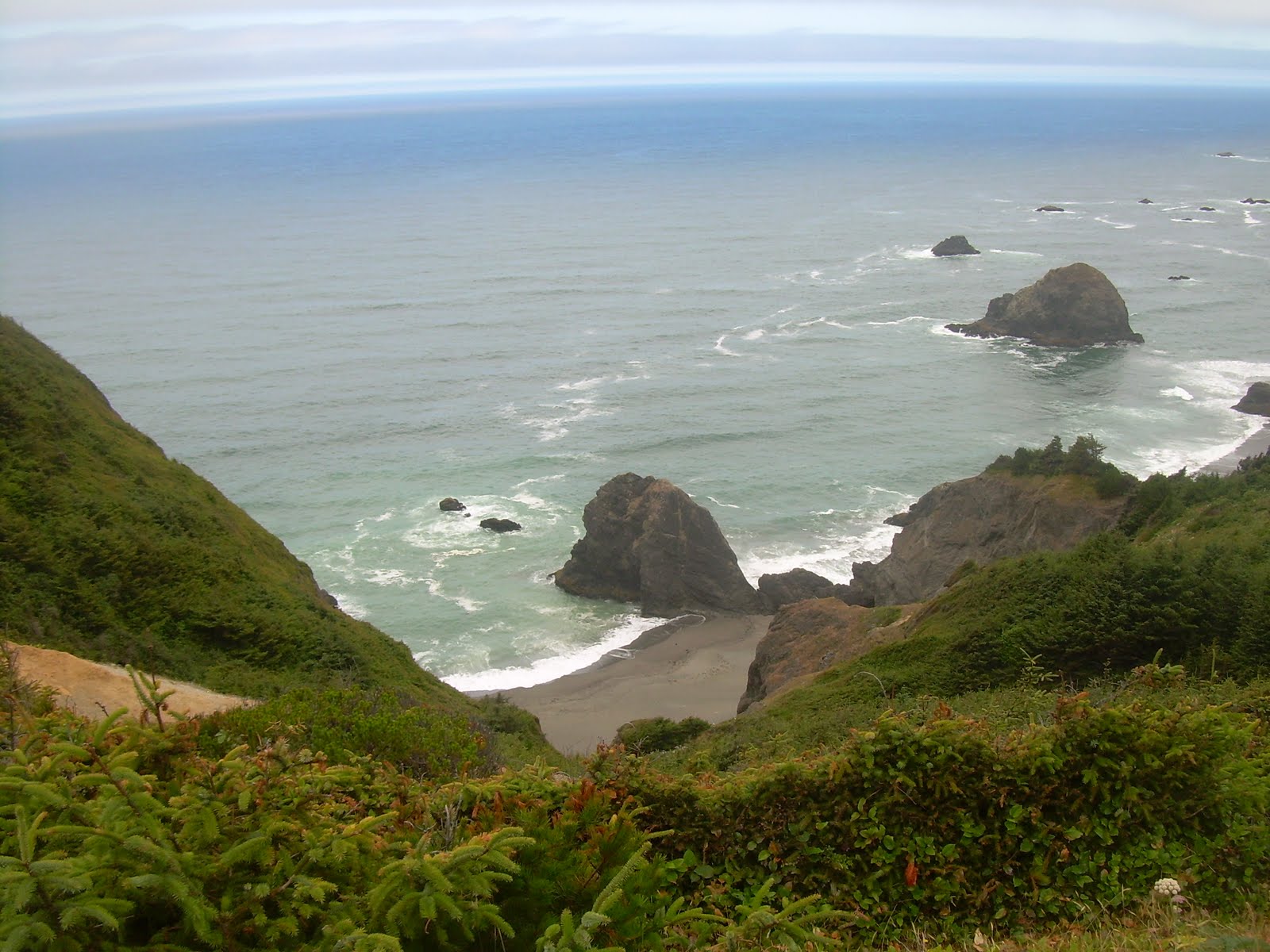
The Oregon coast is rugged and beautiful, with thousands of rocky islets dotting the bays and river mouths.   The towns are mostly small and spread out, but the through traffic on 101 is relentless.  Log trucks and giant motor homes shot past constantly, buffeting me with their backdrafts and, especially in the narrow sections, threatening to blow me off the road.  The riding was not fun.  It's hard to enjoy yourself when you're having a near-death experience every five minutes or so.


Most summer days in these parts start with a damp, drizzly fog rolling in from the sea.  Usually, this lifts by lunchtime and the afternoons are sunny with a cool breeze from the north - a convenient tailwind for a southbound cyclist.  Some days it doesn't lift, and the whole day is gloomy and damp, with low visibility on the narrow, hilly roads - especially on the crests and peaks.  It was on a typically foggy morning, on one of my detours away from US101 on a scenic parkway, that I had my first encounter with the giant Coastal Redwoods.  I rounded a bend and there they were, looming out of the fog - spooky and awe-inspiring.  For the next couple of hours I rolled silently along the quiet road, just gaping at these fabulous trees.  They are the tallest living things on Earth, and they can live for 2,000 years.  They have existed here in these moist, misty coastal hills for 20 million years, and have survived climate change, volcanic upheavals and massive movements of the Earth in this volatile geological region. In the last century and a half they have been decimated by logging, and - believe it or not - they are still being logged!  Is there no limit to the rapacity and greed of human beings?  Once back on Highway 101, I noticed that the squadrons of log trucks that were passing me all carried the carcases of magnificent Redwoods, destined to become building timber.  It literally made me cry.


I wasn't alone for long though: on day three, I met Jeff, an Australian who lives in Vancouver and works as a set designer in the film industry.  He was cycling from BC down to Los Angeles, where he had an appointment with his agent.  I'm not sure whether he always cycles 1000 miles to attend appointments.  We rode together and chatted for the rest of the day, then shared a Chinese meal, a bottle of wine and a motel room in Crescent City that night.


While the coastal scenery remained much the same, crossing the California state line ushered in a whole new cultural landscape.  Rambling, ranch-style homes appeared immediately, as did roadside fruit stalls, alternative - looking people with unconventional clothes and hairstyles, VW Kombi vans, shop signs in Spanish as well as English, organic food shops and even more traffic.  The weather didn't improve much.  Some afternoons the fog lifted around three or four o'clock and the day finished with weak but welcome sunshine and a chilly breeze.  Other days it stayed foggy until dusk.


I camped in state parks and forest  campgrounds, and met a succession of other riders battling the traffic up or down the Pacific Coast.  Three jovial Swiss men were riding from Vancouver to Chile.  A Canadian was riding from Vancouver to somewhere in Northern California to visit his sister.  A hulking Dane was completing a half circumnavigation of the globe on his bike.  He had started in China, tracked through Southeast Asia, and cycled against relentless headwinds from Darwin to Brisbane.  He was a tough man, physically and mentally.


Six days after leaving Florence, I reached the urban fringe of San Francisco.  One last night of camping in a state forest reserve, and I packed my tent up for the last time. I stopped on the waterfront in Sausalito to photograph the Golden Gate and Alcatraz across the bay, but the fog obscured most of the city and the wind was freezing.  And this is summer.  Eventually, I climbed the last of a long succession of steep, winding hills and rode on to the bike path across the bridge itself.  Welcome to San Francisco.  Coming the other way across the bridge were thousands of pedestrians and hundreds of cyclists.  Threading my way through them amidst the roar of the traffic and the shuddering vibration of the bridge was a serious strain, but it didn't diminish the sense of achievement and, yes, pride, that I had pedalled my bike all the way from Washington DC - close on 5,000 miles. 

Must have taken a wrong turn somewhere!

I had intended to spend several days in SF, rekaxing and taking in the sights, but the hostels were all booked out, there was nowhere within 20 miles to camp, and I ended up in a downtown motel room that smelt like an ashtray, had cigarette burns on the furniture, mould in the shower, and cost $75 a night.  I rang Qantas to find out when I could get a flight, and the choice was the very next day or a week hence.  I decided to bolt for home.


I'll post one more blog entry for the journey, with some reflections on the ride and impressions gained from my one day walking around San Francisco.  For now, it's quite nice to have the bike packed up in a box, and not to be riding for a while.

Friday, July 30, 2010

Almost there.


While planning this trip, I imagined it would be a little like my previous cycle tours in Tasmania, New Zealand, Britain and Ireland.  There would be lots of time off the bike - hiking,  swimming, kayaking perhaps, visiting various attractions - so I'd need a decent range of off-bike clothes and accessories.  In fact, I've carried these things, almost unused, right across the country.  The tour has somehow turned into a whirlwind ride across America, in which the pleasure of covering the distance - of actually cycling across a continent - has been as important as visiting significant places.  On reflection I think this has happened because I'm on a designated cycle route - the TransAmerica Trail - that has maps and specific destinations, while my earlier tours have been improvised using general maps and information, and my own curiosity to plot the route.  I had intended to deviate from the Trail and visit the Grand Canyon and Glacier National Park but I've come to realise that these are part of another trip.  This one is about seeing America from the saddle of my bike and I'm loving it.  Believe me there's plenty to see.


Rolling through the wide glacial valleys and over the mountain passes of Montana has been one of the most enjoyable parts of the trip.  I share Steinbeck's enjoyment of this vast, empty place, and I even concur with its fairly corny tourist hook of "Big Sky Country".  Although the the geography is radically different - the fourteen thousand foot snow-capped mountains for a start - there's something reminiscent of Australia here.  There's a sense of of space, of uncrowdedness that definitely speaks to my little outback soul. 


If Montana was about sweeping vistas and soaring peaks, Idaho was all wild rivers and pine forests.  After our lovely, hedonistic rest day in Missoula we climbed the Lolo Pass (nine thousand and something feet), crossed the state line at the summit, and rolled gently downhill along the Lochsa River for what became the easiet ninety mile day ever.  After the pass, we hardly pedalled for the rest of the day: we just coasted and admired the scenery. 

The pay-off, two days later, was a tough day that included three mountain passes and a headwind.  The Cycling Gods never let you get away with an easy day: there's always retribution. 


Gain a Belgian, lose a Belgian.

Just before we crossed the pass, I glanced in my rear-vision mirror and saw another cyclist overhauling us.  He greeted us in what I thought was Dutch, but was in fact Flemish.  Sieman had been in touch with our Belgian contingent, Stefaan and Wim, via their blogs and email, for weeks. Being tired of riding alone, he had put in a 150 mile day to catch up with us.  Two days later, Stefaan left us to chart his own course to Portland, Oregon.  We had swapped a generous, funny, compulsive organiser (labelled the Belgian Bullet because of his strange evening headwear in Yellowstone), for a delightfully disorganised and whimsical 20- year-old political science student with some surprising capabilities of his own - including bicycle spoke replacement.

Ryan the "spokesman".

Despite a day of coasting downhill in the Lochsa Valley, Ryan still managed to break a spoke.  His response to these mishaps is to improvise with string (actually FibreFix emergency spokes) and to resolutely refuse to carry the necessary tools to remove his rear derailleur cassette which must be done to insert a new spoke on the drive side - the side where they nearly always break.  Geordie logic?  We all appreciate the entertainment of watching his rear wheel wobble precariously as he descends steep and dangerous mountain passes. 


The long-awaited return of the Religion Report.

As we've moved west, the number of churches per per town has diminished, as have the weirder religious billboards, the Ten Commandments signs in front gardens, and the American flags flying outside private houses.  I can only conclude that the average western American is much less pious and patriotic than his eastern compatriots - a poor moral specimen altogether.  Just when I was becoming despondent though, there it was, right by the side of the highway in rural Idaho: the Yahweh 666 Warning Assembly!  I noticed that this august group had also joined the Adopt a Highway program, commiting them to cleaning up the litter along a two-mile stretch of road.  It seemed just a little incongruous to me.  I mean, if their warnings about the imminent apocalypse are accurate, who cares about about a few McDonalds wrappers and beer cans on the roadside!


Nearing the end of the trail.

It took us just four days to track across Idaho in a southwesterly direction before entering Oregon - the last state on the TransAm for an East-West rider.  Again we were coasting down a river valley - this time the Snake River.  I was out ahead of the group, having made an early start.  The road was quiet; the morning sunny and still.  As I quietly glided around a bend, there in front of me was a bear.  It was a young Black Bear, about the size of a very large dog, and it was preoccupied with the ripe blackberries at the side of the road.  I'd read that the colour of Black Bears could actually vary quite a lot, and this one was a beautiful gingery brown with a large tuft of blond-tipped hair between its shoulder blades.  Just been to the hairdresser (beardresser?) I guess.  I gently coasted to a stop and reached for my camera, which unfortunately was in my rear pannier and not easy to get to.  I must have made a noise, because it looked up, nearly jumped out of its skin, and scrambled straight up an almost sheer rocky bank, huffing and puffing with effort and fright.  It got to the top, took one horrified look back at me, and disappeared into the pine forest.  The whole episode took less than ten seconds I suppose, and I got nowhere near my camera, but it put a smile on my face for the rest of the day.

An encounter made in heaven.

Last night (July 29th) we camped in the park at Mitchell, Oregon, a tiny town in the dry prairie country that covers most of the centre and east of the state.  It had been a hot day's riding with a fairly serious mountain pass in the middle of it, and we settled down in the town's only cafe / bar for a few cold beers and a hamburger before setting up camp by the creek just across the road.  A group of four cyclists, all men in their 50s, arrived from the east, followed by their support crew - their wives - who were carrying their gear in a car.  They were a sort of semi-official club, complete with matching cycle shirts which identified them as The Clydesdales, and indeed, they were all hefty specimens.  We soon discovered something else about them: they were all California winemakers and vineyard owners from the Napa Valley, and the support vehicle contained about 200 bottles of theire own produce, some of which they generously shared with us.  The wine was excellent, the company exceedingly friendly, and the night became quite a long one.  As we finally staggered off to bathe in the freezing creek and set up camp, we were all invited to visit and stay with them in Napa should we ever be passing that way, and guess what!  In a couple of weeks, I will.

The last pass.

Today (July 30th), carrying our hangovers with us, we climbed over the Ochoco Pass (four thousand and something feet) and coasted down to Prineville, where I'm sitting in the excellent public library writing this before riding the last 20 miles to Redmond where we'll stay tonight.  Tomorrow, we cross the last mountain pass (although certainly not the last big hill) of the TransAm: McKenzie Pass, which will take us over the Cascade Range and down to the cool, damp, foggy Pacific Northwest coast.  In two days time I will have cycled across a continent, but that's not the end for me.  Another 10 days or so of riding will take me down the Pacific Coast Trail to San Francisco.